· 15 min read
Ecommerce Conversion Rate by Industry
Explore the latest ecommerce conversion rates by industry in 2025. Discover key trends and insights to enhance your online sales strategies. Read more!
Ecommerce
Your conversion rate isn’t low. Your benchmark is wrong.
That’s the problem nobody in ecommerce wants to say out loud. You read that the average conversion rate is 2-3%, you’re sitting at 1.8%, and now you think you’re failing. You’re not. A 1.8% conversion rate in luxury jewelry is exceptional. The same 1.8% in food and beverage means you’re leaving a fortune on the table.
The global average ecommerce conversion rate sits at 2.5-3.0% across all industries. That number is nearly useless on its own. Food and beverage brands average 5.39-6.11%. Luxury and jewelry brands average 0.95-1.19%. Lumping those together and calling it “the benchmark” is like comparing a Ferrari’s fuel economy to a school bus and wondering why your sports car is underperforming.
Here’s what actually matters: your rate relative to your industry, your traffic source, and your device mix. Everything else is noise. Let me break it down.
What Is the Average Ecommerce Conversion Rate by Industry in 2026?
The global average ecommerce conversion rate in 2026 sits at 2.5-3.0% across all industries. The US average runs slightly higher at 2.3-2.7% (Shopify aggregate, 2024). EU ecommerce averages 1.7-2.0% — a persistent 0.5-0.7 point gap driven by longer checkout flows, GDPR friction, and more complex payment rails.
Those headline numbers hide everything important. The real industry-level spread runs from 0.95% for luxury jewelry to 6.11% for food and beverage — a 6x range within the same benchmark category of “ecommerce.” Using the 2.5% average to diagnose a luxury store is like measuring marathon performance against a sprinting benchmark.
For Shopify merchants specifically: the median conversion rate across 2,800 stores is 1.4% (Littledata 2023). Top 20% of Shopify stores hit 3.2% or above. Top 10% break 4.7%. Those are your ecommerce benchmarks if you’re running a mid-market DTC brand — not Dynamic Yield’s enterprise-weighted 3.41%.
The conversion rate benchmark that actually helps you is the one segmented by your industry vertical, your primary traffic channel, and your primary market. Everything below gives you exactly that.

“My conversion rate is fine.” — Nobody who actually checked their industry benchmark.
What a “Good” Ecommerce Conversion Rate Actually Means for Your Store
Stop chasing a number. Start chasing context.
A 3% conversion rate is considered solid across ecommerce as a whole. But 3% in pet supplies puts you below the category average of 2.50-3.20%. In luxury watches, 3% would make you a category leader, since the benchmark sits at 0.95-1.19%.
Here’s the honest breakdown by business size:
Enterprise brands (running sophisticated personalization, dedicated CRO teams, high-intent traffic) consistently hit the top of their industry range. Dynamic Yield’s dataset, which covers 200 million monthly users across 400+ enterprise brands, shows industry-leading rates because their clients include Sephora, IKEA, and McDonald’s.
Shopify merchants face a different reality. Littledata’s 2023 benchmark across 2,800 Shopify stores puts the median at 1.4%. The top 20% hit 3.2% or above. The top 10% break 4.7%. Those are the real goalposts if you’re running a mid-market DTC brand.
What that means for you: if you’re comparing your Shopify store against enterprise benchmarks, you’re setting yourself up for unnecessary panic or false comfort. Always match your benchmark to your business size, not just your industry.
The goal isn’t a high conversion rate. The goal is a conversion rate that’s above your competitive baseline, improving quarter over quarter, and generating profitable revenue per visitor.
Ecommerce Conversion Rate by Industry: The Full Breakdown
Here’s where your category actually sits. These figures come from Dynamic Yield’s 12-month average ending November 2024, cross-referenced with IRP Commerce’s UK live merchant data and Littledata’s Shopify benchmarks.
| Industry | Conversion Rate Range | Context |
|---|---|---|
| Food and Beverage | 5.39-6.11% | Highest CVR, necessity and repeat purchases |
| Beauty and Personal Care | 4.55-5.74% | Strong loyalty, replenishment cycles |
| Multi-Brand Retail | 4.04-4.50% | Breadth plus promotional strength |
| Arts and Crafts | ~4.79% | High intent, engaged niche audiences |
| Health and Wellness | ~3.37% | Supplements, repeat purchase behavior |
| Kitchen and Home Appliances | ~3.32% | Higher intent than general home |
| Consumer Goods | 2.89-3.43% | Broad category, habitual buying |
| Pet Care and Veterinary | 2.50-3.20% | Low cart abandonment, necessity purchases |
| Fashion and Apparel | 2.00-3.41% | Wide range, size anxiety drags it down |
| Electronics | 1.90-2.41% | Price comparison, long research cycles |
| Sports and Recreation | 1.60-2.03% | Moderate consideration, seasonal swings |
| Automotive Parts | ~1.43% | High specificity, compatibility concerns |
| Home and Furniture | 1.24-1.71% | Long decision cycles, high ticket |
| Luxury and Jewelry | 0.95-1.19% | Lowest CVR, highest AOV |
Food and Beverage: 5.39-6.11%
This category dominates because the purchase decision is already made before the visitor arrives. You don’t browse coffee brands when you’ve run out of your usual one. You buy it.
Repeat purchases, subscription models, and necessity purchasing all collapse the consideration phase. Shoppers don’t research, compare, or abandon. They buy. That’s why food and beverage also carries one of the lowest cart abandonment rates at 63.62%, well below the 70.22% global average.
If you’re running a food or beverage brand and converting below 4%, you have a checkout or trust problem, not a traffic problem.
Beauty and Personal Care: 4.55-5.74%
Strong loyalty patterns drive this category above the global average. Once someone finds a foundation shade or a skincare routine that works, they return repeatedly with high purchase intent.
The complicating factor: beauty shoppers compare. They add three foundations to cart, deliberate over shades, check reviews, and abandon at a high rate of 81.45%. The category has one of the highest cart abandonment rates despite strong overall conversion, because high-intent buyers do eventually come back and complete the purchase.
Your priority in beauty: reduce that abandonment. Shade finders, virtual try-ons, and detailed ingredient information all close that gap.
Fashion and Apparel: 2.00-3.41%
The wide range here tells the story. Fast fashion brands with clear sizing and cheap returns sit at the top. Luxury fashion brands with complicated sizing, expensive returns, and aspirational positioning sit at the bottom.
Fit anxiety is the category’s biggest conversion killer. Shoppers add items to cart to compare sizes and styles, not to buy. Cart abandonment sits at 78.53%, which is 8 points above the global average.
If you’re in fashion, free or frictionless returns aren’t a cost center. They’re a conversion strategy. Show the returns policy on the product page, not just in the footer.
Littledata puts the average Shopify fashion store at 1.9%. The top 20% of fashion stores hit 4.3% or above. That gap is almost entirely explained by returns policy prominence and size guidance quality.
Electronics: 1.90-2.41%
Electronics shoppers are the most paranoid comparison buyers in ecommerce. They open 12 tabs, read spec sheets, check Amazon pricing, read three Reddit threads, and still don’t buy today.
The consideration phase is long because the stakes are high. A wrong purchase on a $1,200 laptop is a real problem. So shoppers research hard and buy slowly.
That behavior drives conversion down. But it also means the buyers who do convert are high-intent and low-return. Your job in electronics isn’t to rush the decision. It’s to be the most trustworthy option when the decision is finally made.
That means comparison tables, visible warranty details, and reviews that address real objections. Surface the spec comparison tool on the product page. Don’t bury it two clicks deep.
Home and Furniture: 1.24-1.71%
A 30-36% cart-to-conversion ratio in this category is a feature, not a bug. Shoppers use their cart as a wishlist. They save a couch they want to think about for six weeks. When they’re ready, they come back.
The purchase cycle for major furniture can be months. You’re not going to collapse that with urgency tactics or countdown timers. What you can do: show dimensions, room scale visualizations, and delivery specifics on the product page so when the decision is made, it’s made in your favor.
BNPL (buy now, pay later) options on product pages increase conversion in this category by reducing the payment shock on high-ticket items. If you’re selling items over $500 without visible financing options, you’re losing buyers who are already sold.
Luxury and Jewelry: 0.95-1.19%
The lowest conversion rate in ecommerce. Also the highest average order value. Those facts are directly connected.
82.84% cart abandonment, the highest of any category, reflects buyers who are genuinely interested but unwilling to commit online. They want to see the ring in person. They want to talk to a sales associate. They trust a boutique more than a checkout page.
Your benchmark in luxury is not 2-3%. It’s 1-1.5%. If you’re hitting that, you’re winning. The lever isn’t conversion rate optimization in the traditional sense. It’s trust-building: certification transparency, provenance documentation, concierge chat, and white-glove delivery.
Sporting Goods and Recreation: 1.60-2.03%
Seasonality swings this category significantly. Running gear converts in January. Ski equipment converts in October. Camping supplies peak in spring. Your benchmark varies by season, and annual averages mask the real picture.
Cross-reference your rate against the same period last year, not against the general benchmark. A 1.6% conversion rate in February for skiing equipment might be above average. The same rate in November is a problem.
Health and Wellness: ~3.37%
Supplements, fitness programs, and wellness products benefit from high purchase intent. Consumers researching health solutions are motivated buyers. The category hits 3.37% because by the time someone finds your magnesium supplement, they’ve already decided they need magnesium.
Trust is the conversion variable here. Third-party certifications, clinical study citations, and transparent ingredient sourcing convert the research-phase visitor into a buyer. Without those signals, the category’s inherent intent advantage gets wasted.
EU vs US: The Regional Gap That Changes Your Benchmark
If you’re a European merchant comparing yourself to US benchmarks, you’re almost certainly measuring against numbers that are too high. EU ecommerce conversion rates run consistently lower than US figures, and the gap varies by category.
Here’s the EU vs US breakdown:
| Category | US Benchmark | EU Benchmark | Gap |
|---|---|---|---|
| Fashion and Apparel | 2.0-3.4% | 1.3-2.5% | 0.7-0.9 pts |
| Food and Beverage | 5.4-6.1% | ~5.5% | Roughly equal |
| Luxury and Jewelry | 0.95-1.19% | ~0.6% | 0.35-0.6 pts |
| Multi-Brand Retail | 4.0-4.5% | ~2.93% (EMEA) | ~1.1 pts |
| Electronics | 1.9-2.4% | ~2.2% (Germany) | Varies by country |
The UK is the outlier. UK merchants consistently outperform both EU and US benchmarks, averaging 3.30-4.10% across categories. Dense logistics networks, next-day delivery expectations, high digital wallet penetration, and mature online shopping habits all contribute. If you’re benchmarking against UK data, you’re measuring against one of the most optimized ecommerce markets in the world.
Germany converts at ~2.22% on average, dragged down by a cultural preference for invoice payment and BNPL options. German shoppers expect to pay after delivery. If you don’t offer invoice payment or Klarna in Germany, you’re losing a material percentage of buyers who would otherwise convert.
The Netherlands, France, and the Nordics each have their own quirks. Dutch shoppers heavily favor iDEAL. Nordic shoppers expect fast shipping despite remote geography. Adapting to local payment preferences is the single highest-leverage conversion action for EU merchants entering new markets.
EMEA overall sits at ~2.93% for conversion and ~6.27% for add-to-cart rates, both below the Americas’ 3.14% and 6.62% respectively.
The takeaway: If you’re a German fashion brand converting at 1.8%, you’re likely performing at or above your real competitive baseline. Stop benchmarking yourself against a Shopify dataset dominated by US and UK merchants.
Why Rates Vary So Much by Industry
Four factors explain the gap between a 6% food and beverage rate and a 1% luxury rate.
Price point. The higher the price, the longer the consideration cycle, the lower the conversion rate on any given session. A $12 protein bar converts in one visit. A $4,000 sofa takes six. This isn’t a failure. It’s physics.
Purchase frequency. Categories with frequent repurchase (beauty, food, supplements) build habits. Habits eliminate consideration. Habits collapse the research phase. The repeat customer who buys the same shampoo every six weeks converts at close to 100%. That drags the category average up significantly.
Trust requirements. Jewelry, luxury goods, and high-end electronics all require high trust before a purchase happens. Online builds trust slowly. Offline stores, human sales associates, and physical product inspection build trust fast. Categories with high offline trust requirements consistently convert lower online because the online experience can’t fully replace the in-person one.
Return anxiety. Fashion and furniture both suffer from return anxiety, but in opposite directions. Fashion shoppers worry they’ll get the wrong size and have to deal with a painful return. Furniture shoppers worry the couch won’t fit in their living room. Both anxieties suppress purchase decisions. Removing those anxieties with clear returns policies, dimensional guides, and room visualizers directly increases conversion.
Product complexity also matters in electronics and automotive parts, where a wrong purchase creates compatibility problems. A shopper buying RAM for their laptop needs to know it’s compatible before buying. If your product page doesn’t answer that question definitively, they leave.
B2B vs B2C conversion rate by industry. B2B ecommerce conversion rates run 1.0-2.5% on average — numerically similar to B2C, but the interpretation is entirely different. A B2B sale at 1.5% conversion is often worth 5-10x a B2C transaction in revenue because of higher AOV and recurring contract value. B2B sales conversion rate by industry shows wide variance: SaaS and software self-serve portals average 3-5% (lower price points, high intent visitors), industrial equipment and MRO supplies sit at 0.5-1.0% because purchase decisions involve procurement cycles and multiple approvers. Don’t benchmark your B2B portal against B2C ecommerce averages. The visitor intent, decision complexity, and purchase authority are fundamentally different.
Traffic Source and Email Marketing Conversion Rate by Industry
Here’s what nobody tells you in the benchmarks: conversion rate by industry assumes a blended traffic mix. Your actual rate depends more on where your traffic comes from than what industry you’re in.
Email traffic is the highest-converting source across all categories, typically converting 3-5x better than cold paid social traffic. Your email subscribers know you. They’ve bought from you. They came back because they wanted to. Of course they convert better.
Email marketing conversion rate by industry also varies substantially. In food and beverage, promotional emails to existing customers convert at 8-12% because the purchase decision is habitual. In fashion and apparel, email conversion runs 4-7% for segmented campaigns. In electronics, email converts at 2-4% — lower because even loyal customers research before they buy. Knowing your channel-specific benchmark matters as much as knowing your industry baseline.
Approximate conversion by source:
| Traffic Source | Typical Conversion Rate |
|---|---|
| Email (existing customers) | 4-8% |
| Direct traffic | 3-5% |
| Organic search | 2-4% |
| Paid search (branded) | 3-6% |
| Paid search (non-branded) | 1-3% |
| Paid social (retargeting) | 1-3% |
| Paid social (cold) | 0.5-1.5% |
| Organic social | 0.5-1.5% |
If your store has been scaling paid social aggressively, your overall conversion rate is probably falling even if your CRO has improved. You’re adding lower-intent traffic faster than optimization can compensate. That’s not a design problem. That’s a traffic mix problem.
Before you hire a CRO agency, segment your conversion rate by traffic source. If email is converting at 6% and cold paid social is converting at 0.8%, you’re fine. Your blended 2.1% isn’t a sign of a broken site. It’s a sign that your traffic mix is heavy on cold acquisition.
The actionable version: when you benchmark your conversion rate against industry data, use your organic search and direct traffic rate as the comparison point. Organic visitors and direct visitors are roughly equivalent to the “engaged shopper” profile most benchmark studies use. Your cold paid social traffic is not in those benchmarks.
Mobile vs Desktop: Where Your Conversion Is Really Leaking
Mobile drives 68-79% of all ecommerce traffic. Mobile converts at 1.80-2.92%. Desktop drives 22-30% of traffic. Desktop converts at 3.13-3.90%.
That gap, 35-70% better conversion on desktop despite a fraction of the traffic, is the single largest structural opportunity in ecommerce right now.
Here’s the industry-level device breakdown:
| Category | Mobile CVR | Desktop CVR | Gap |
|---|---|---|---|
| Fashion (Shopify avg) | 1.2% | 1.9% | 58% gap |
| Food and Beverage (Shopify avg) | 1.2% | 2.2% | 83% gap |
| Overall (Shopify top 10%) | 3.9% | 6.5% | 67% gap |
| All ecommerce (blended) | 1.80-2.92% | 3.13-3.90% | 35-70% gap |
The reasons are straightforward. Mobile screens make product evaluation harder. You can’t easily compare specs, zoom into details, or read long descriptions on a 6-inch screen. Form fields are painful on mobile keyboards. Not every merchant has Apple Pay or Google Pay enabled, forcing manual card entry that kills momentum. And mobile shoppers are often browsing during divided-attention moments: commuting, watching TV, waiting in line.
Closing half the mobile-desktop gap on a store doing $2M in revenue is worth $300,000 or more in recovered conversion. The math is simple. The execution is where most brands drop it.
What actually moves mobile conversion:
Thumb-friendly navigation with large tap targets is the floor, not the ceiling. The real lever is one-click checkout. Apple Pay, Google Pay, and Shop Pay take a 14-step checkout process and collapse it to a single biometric confirmation. If you don’t have those enabled and mobile is 70% of your traffic, you’re running a conversion leak that’s hard to overstate.
Beyond that: address autofill, card scanning, and a minimal checkout form (guest checkout by default, not buried behind account creation) consistently add 0.3-0.8% conversion points on mobile.
Test your own site on a real mobile device, on a 4G connection, with cold eyes. The things that will kill you are obvious within 60 seconds.
How to Use Benchmarks Without Being Fooled by Them
Benchmarks are comparison tools. They’re not targets. Here’s how to use them correctly.
Match your benchmark to your business size. Dynamic Yield’s enterprise benchmarks represent what’s possible with heavy CRO investment. Shopify/Littledata benchmarks represent typical SMB reality. If you’re a $500K/year Shopify store, benchmark against the Littledata median (1.4%), not against Dynamic Yield’s fashion average (3.41%). Using the wrong benchmark turns a good performance into a panic trigger.
Segment before you compare. Your overall conversion rate is almost meaningless for diagnosis. Segment by device, by traffic source, by returning vs new visitors, and by product category. Returning customers convert 2-3x higher than new visitors. If your returning customer rate is growing, your blended rate might fall even as your site gets better. That’s a success story, not a failure.
Use the same traffic denominator. Most industry studies use unique visitors. Some use sessions. A visitor who comes to your site three times and buys once has a 100% visitor conversion rate but a 33% session conversion rate. If you’re comparing your GA4 session-based data against a visitor-based industry benchmark, you’re comparing apples to raisins.
Compare same-period data. A November conversion rate looks nothing like a February rate. Compare your November to last November, not to your own September. Seasonality accounts for 15-36% variation in conversion rate across most categories.
Don’t optimize conversion rate at the expense of margin. A jewelry brand running 50% off everything will convert at 3%. But the business math might be terrible. Conversion rate without revenue per visitor, average order value, and gross margin is a vanity metric.
How to Improve Your Conversion Rate Relative to Your Industry Benchmark
You’ve benchmarked yourself correctly. You know the gap. Here’s how to close it, by where the gap actually lives.
Gap in cart abandonment (above 75% in a non-luxury category):
Fix checkout first. Not your homepage. Not your product pages. Checkout. Baymard estimates that optimizing checkout UX recovers 35.26% of potential lost sales on average. Start with: remove forced account creation (add 15-30% recovery), show shipping costs on the product page before cart, and add Apple Pay/Google Pay for one-step mobile checkout. Those three changes alone typically move abandonment 5-12 points.
Gap in add-to-cart rate (below your category average):
Your product pages aren’t doing their job. The three most common failures: weak product photography (especially for fashion and home), missing size/dimension information, and buried social proof. Reviews that address real objections convert better than star ratings. Video on product pages increases add-to-cart by 80% in apparel. Measurement guides reduce size anxiety in fashion by giving shoppers a reason to commit.
Gap in mobile conversion (less than 50% of your desktop rate):
Enable one-click checkout wallets today. That’s step one and it’s not optional. Step two: run a mobile session recording (Hotjar, Microsoft Clarity) and watch 20 real mobile sessions. You’ll see exactly where people rage-tap and drop. Then fix those points. Step three: test your checkout flow on a real mobile device with a real address on a 4G connection. Count the steps. Anything above 4 steps is too many.
Gap in overall rate vs category benchmark:
If your overall rate is 40%+ below your category benchmark after segmenting correctly, you likely have a trust problem. Trust problems show in high exit rates on checkout (people second-guessing at payment), low return visitor rates, and poor performance from direct traffic. Fix: add trust signals at checkout (security badges, money-back guarantee visible on payment step), surface real customer reviews prominently, and ensure your refund policy is easy to find and easy to understand.
Specific improvements by category:
Fashion and apparel: Make returns frictionless and say so on the product page. Size guides with real measurements, not just S/M/L. UGC showing the product on diverse body types. Express checkout buttons above the fold on product pages.
Home and furniture: AR or 3D room visualization if you can justify the investment. Financing on product pages for items over $400. Explicit delivery timeline (not just “3-5 business days” but “order today, delivered by March 15”). Detailed assembly and dimensions in a tab, not a PDF.
Electronics: Compatibility tools. Comparison tables. Warranty details front and center. Reviews segmented by use case (“bought this for gaming,” “use this for video editing”). Price-match guarantee if you’re not the lowest price.
Luxury and jewelry: Don’t chase conversion rate. Chase trust. High-resolution photography, certification documentation, provenance storytelling, and concierge live chat for pre-purchase questions. One conversion assisted by a chat conversation is worth more than a hundred abandoned sessions from a discount popup.
Food and beverage: Subscriptions. You’re already converting well. The growth lever is repeat purchase frequency and lifetime value. An auto-ship program that saves the customer 10% on each order and saves you the acquisition cost on repeat purchases is worth more than optimizing a conversion rate that’s already at 5.5%.
The Honest Version of What to Do Next
Here’s where I land on all of this.
Most ecommerce brands have a benchmark problem before they have a conversion problem. They’re measuring themselves against the wrong number, panicking over a rate that’s actually competitive, and throwing traffic acquisition budget at a problem that doesn’t exist.
Or the opposite: they’re underperforming their benchmark by a significant margin but blaming the economy, the algorithm, or their category, when the real issue is a checkout flow that requires account creation and doesn’t accept Apple Pay.
Run this diagnostic now. Pull your conversion rate by device. Pull it by traffic source. Pull it by returning vs new visitors. Compare those segments against the category benchmarks above, not your blended overall rate. Then you’ll know exactly where the gap lives and exactly what to fix.
That’s the work. Everything else is benchmarking theater.
What to Read Next
Benchmarks tell you where you stand. The next step is understanding why your rate is where it is and what to fix first.
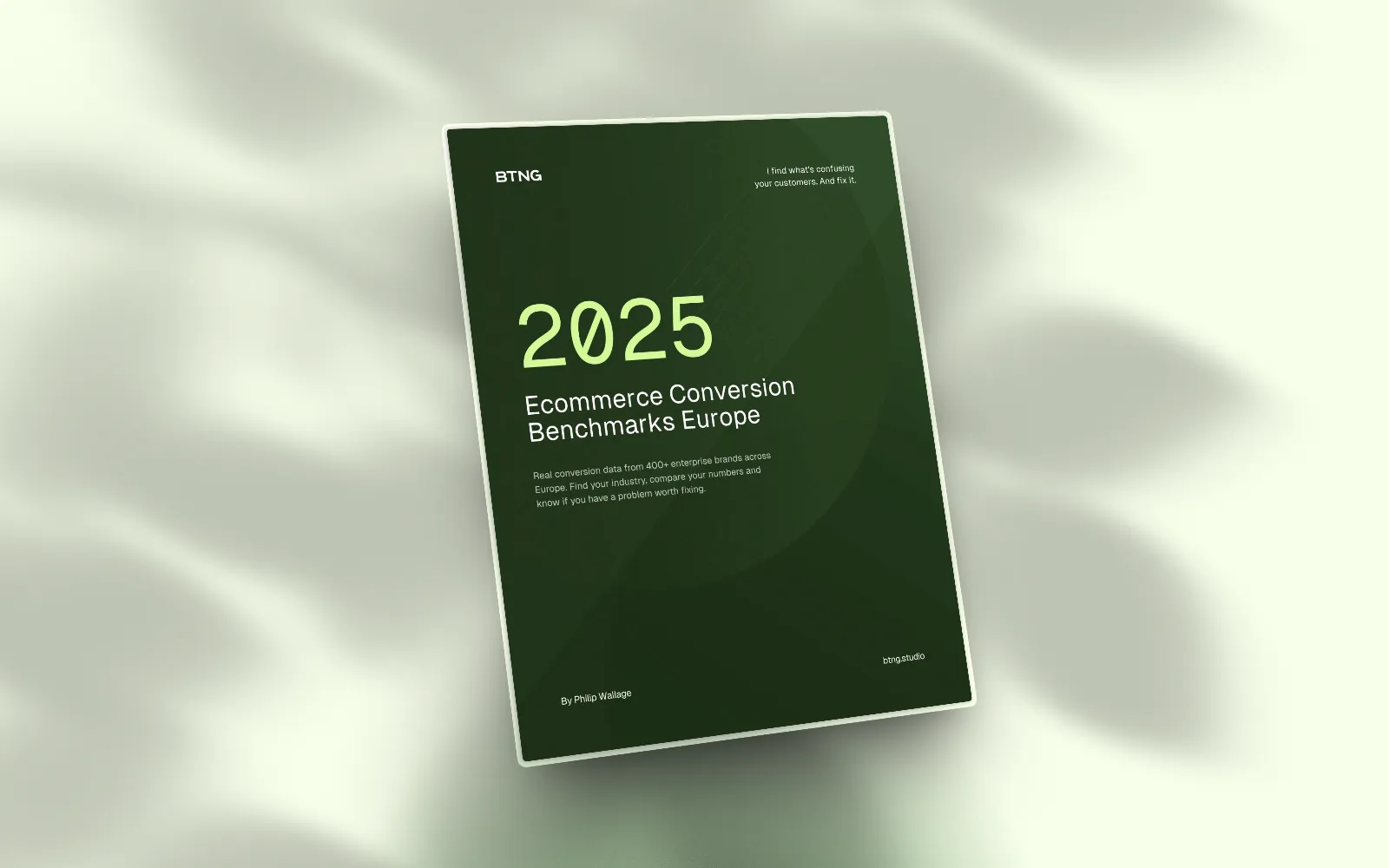
- E-commerce Conversion Benchmarks Europe 2025 - free guide with European-specific benchmarks across 12 industries, including Netherlands data and EU vs US context
- The Ultimate Guide to CRO for Ecommerce - the complete framework for improving your rate systematically
- The Conversion Diagnostic Framework - a structured process for identifying your actual drop-off points
- Top 12 Tips for Ecommerce Checkout Optimization - checkout is where conversion dies. Fix it here.
- Book a free e-commerce UX audit preview